
Datamine Smart Contract Security Enhanced with Hardhat Testing
💡 AI Article Summary
Upgrading to Hardhat for Advanced Testing
Datamine Network has successfully migrated its original FLUX smart contract unit tests from the legacy Drizzle framework to Hardhat. This migration modernizes the development workflow and makes it significantly easier for security researchers and community developers to test, verify, and audit the ecosystem's core smart contracts.
Securing ERC777 Hooks Against Re-Entry
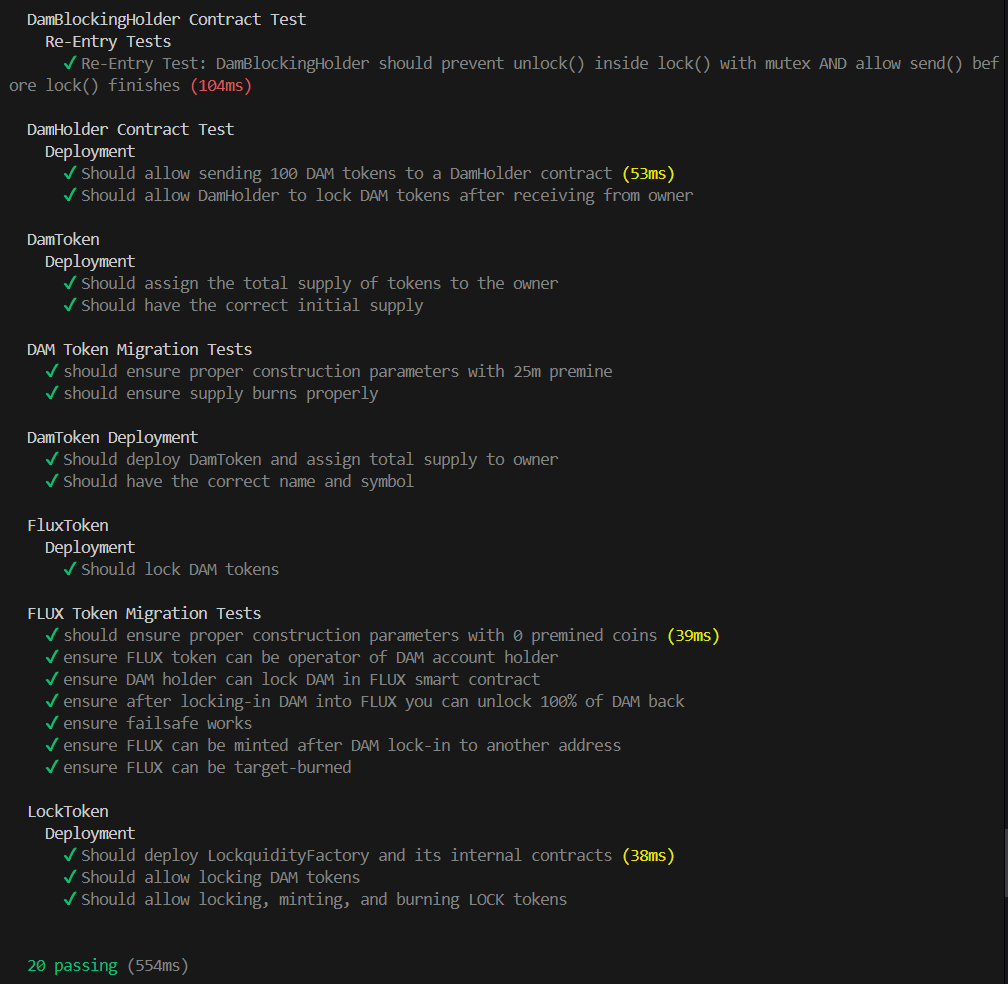
As part of this upgrade, a highly complex unit test was introduced within DamBlockingHolderContractTests.ts to simulate and analyze potential re-entrancy attack vectors associated with ERC777 token hooks.
Because ERC777 tokens utilize transfer hooks, they require precise security safeguards. The newly implemented test validates that while a user can spend their remaining DAM balance before the lock() function fully completes, the smart contract's mutex protection successfully prevents calling unlock() prematurely. This guarantees that even if a re-entry attempt occurs, it cannot cause any unwanted side-effects or compromise the vault.
This rigorous test demonstrates the robust design of the ecosystem's mutex protection, ensuring the core burning and locking mechanisms remain completely secure.
You guys might have been wondering what I've been working on recently. I've migrated all of our original FLUX smart contract unit tests into Hardhat (it was using Drizzle which is outdated now).
After that I've spent a bunch of time writing a very complex unit test.
There is a very complex unit test (inside DamBlockingHolderContractTests.ts) that involves ERC777 hooks to showcase how re-entry attacks would work.
The goal of this test is to showcase that while re-entry is possible, it does not lead to any unwanted side-effects.
In this test I showcase that you can spend DAM balance before lock() finishes.
Specifically it shows that you can't call unlock() before lock() finishes with a mutex BUT you can spend DAM balance.
This is an important new test as it showcases that our mutex protection works on the core burning functionality.
ERC777 is tricky due to these re-entry attacks but I am happy we spent enough time in beginning to safely protect us.
Now with these unit tests we can be sure the ecosystem is secure and working as intended.
These unit tests also make it easier for other security researchers to test their theories.
I'll release these tests tomorrow, it's another amazing step towards building trust and safety 
Frequently Asked Questions
Why did Datamine migrate its smart contract tests to Hardhat?
Datamine migrated its legacy Drizzle-based unit tests to Hardhat to leverage a more robust and modern testing framework. This transition simplifies the testing process and makes the codebase more accessible for security researchers to run their own audits.
What security risk does the new unit test address?
The new unit test specifically targets re-entrancy (re-entry) vulnerabilities. Since ERC777 tokens employ transfer hooks that can execute external code mid-transaction, the test ensures that Datamine's smart contracts are fully protected against unauthorized state modifications during token operations.
How does the mutex protect the DAM locking system?
The smart contract features a built-in mutex that locks critical pathways. This ensures that crucial functions, such as unlock, cannot be called recursively while a lock operation is still actively processing, eliminating any potential exploit vectors.
 · hodlforjesus · #dev-updates