
Selecting the Right Ethereum Network for Datamine
💡 AI Article Summary
Understanding Multi-Chain Support in Datamine
The Datamine Network operates across a multi-chain architecture to balance security, speed, and cost-efficiency. Users interact with different layers of the Ethereum ecosystem depending on which tokens they are managing. Specifically, the ecosystem spans Ethereum Layer 1 (L1) and Arbitrum Layer 2 (L2).
Selecting the correct network is essential for managing your assets. For instance, the foundation token, DAM, and the primary utility token, FLUX, are hosted on Ethereum L1. If you are locking DAM to mint FLUX, your Web3 wallet must be set to the Ethereum Mainnet.
Transitioning to Arbitrum Layer 2
To optimize transaction speeds and reduce gas fees, Datamine utilizes Arbitrum L2 for ArbiFLUX and LOCK tokens. While Ethereum L1 transactions can carry high gas costs, Arbitrum reduces these costs significantly, down to approximately one cent per transaction.
To interact with ArbiFLUX, mint LOCK, or participate in the permanent liquidity pools, you must switch your network selection in your Web3 provider (such as MetaMask) to Arbitrum. This multi-chain capability is supported natively within the Datamine dashboard, allowing you to seamlessly transition between Ethereum and Arbitrum configurations.
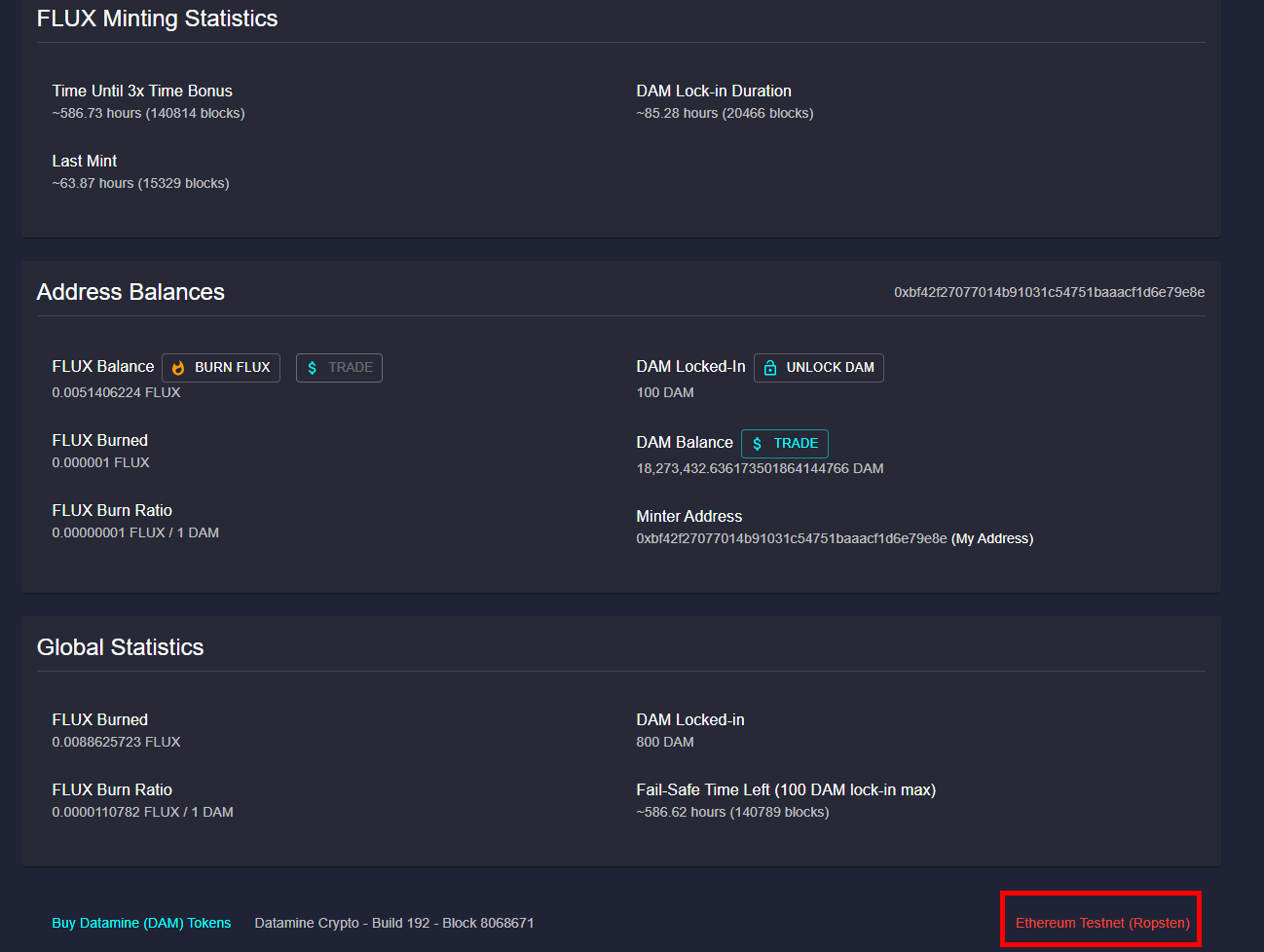
Ethereum Network selection
Frequently Asked Questions
How do I choose between Ethereum and Arbitrum on Datamine?
You can switch networks directly in your Web3 wallet (like MetaMask). Use Ethereum Mainnet for DAM and FLUX transactions, and switch to Arbitrum for ArbiFLUX and LOCK.
What is the benefit of using Arbitrum Layer 2?
Arbitrum L2 offers dramatically lower transaction fees—often around one cent—and faster confirmation times compared to Ethereum Layer 1, making activities like LOCK minting and GameFi participation highly efficient.
Are my tokens safe when switching networks?
Yes. The smart contracts on both layers are audited and completely decentralized. The assets remain secure on their respective chains as you switch your wallet's active network connection.
 · hodlforjesus · #dev-updates